You’re Not Alone (Not Even Close)
If you’ve ever wrapped things up faster than your partner would like during sex and walked away feeling deflated — in more ways than one — welcome to one of the largest clubs in men’s sexual health that nobody talks about.
Research suggests roughly 1 in 3 men will experience premature ejaculation at some point in their lives, making it more prevalent than ED.
And yet, walking into a urology office to talk to a doctor about it ranks somewhere between “asking the boss for a massive raise” and “explaining your browser history to your spouse” on the average guy’s comfort scale.
Most men feel embarrassed about discussing it, which is unfortunate, because the exact causes of premature ejaculation are usually pretty identifiable — and most causes are pretty treatable.
Key Takeaways
- Premature ejaculation is the most common sexual dysfunction in men, affecting roughly 1 in 3 guys at some point in their lives — you're in very crowded company.
- The causes of premature ejaculation are usually a mix of psychological factors (performance anxiety, stress, early sexual experiences) and biological ones (serotonin levels, hormones, prostate issues).
- Lifelong premature ejaculation tends to be more biological, while acquired PE often has a clearer trigger like a new relationship, a new stressor, or a new health issue.
- Premature ejaculation and ED often travel together, and treating one can sometimes resolve the other.
- Most cases respond to some combination of behavioral therapy, the squeeze technique, pelvic floor work, antidepressant medication, or topical numbing agents — you usually don't have to live with it.
So let’s get into it. Below are nine reasons your sexual experience might be ending sooner than you’d like, what’s actually going on under the hood, and what to do about it.
What Even Counts as Premature Ejaculation?
Before we dive into causes, a quick definition. The Diagnostic and Statistical Manual of Mental Disorders (the DSM, the bible of mental health diagnosis) lays out the symptoms of premature ejaculation as: ejaculation happens within about one minute of entering the vagina, occurs sooner than he would like, and has become a pattern of rushing to ejaculate during most sexual encounters for at least six months. It also has to cause distress — if you finish in 45 seconds and you’re both delighted about it, that’s not a cause for concern, that’s just Tuesday.
Premature ejaculation can also be classified as either lifelong (present since your first sexual experiences) or acquired (it developed later after a period when things worked normally). The distinction matters because the symptoms and causes are often different, and so are the most effective treatments.
A quick note on terminology: you’ll also see this referred to as rapid ejaculation or early ejaculation. Same thing. Different names, same finish line.
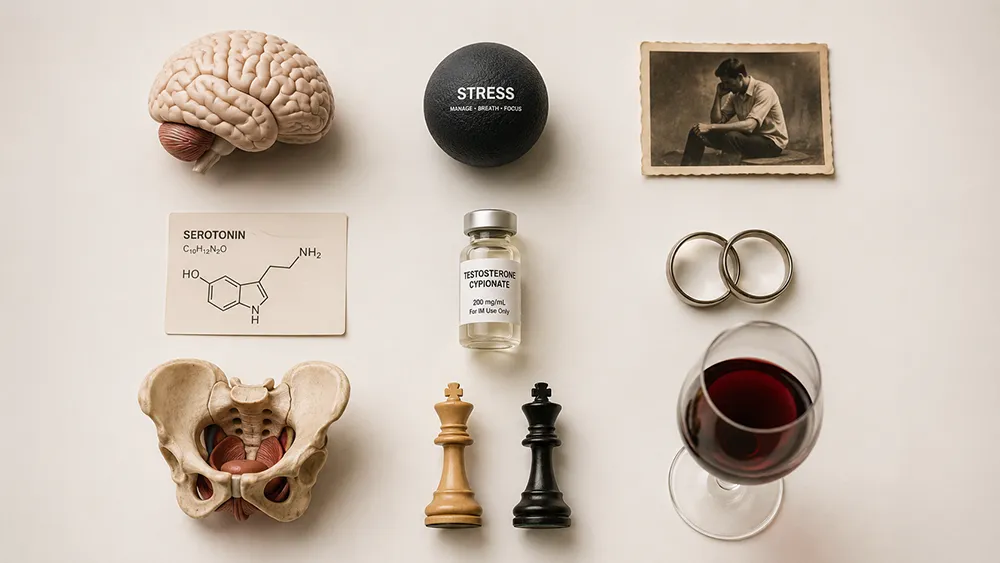
The 9 Causes of Premature Ejaculation
1. Performance Anxiety
If your brain treats sex like a final exam, your body is going to respond accordingly. Sexual performance anxiety is one of the most common psychological origins of premature ejaculation, and it works in a particularly nasty feedback loop: you worry about finishing too fast, the worry triggers a stress response, the stress response makes you finish too fast, and now you have new material for next time’s worry.
This is especially common with new partners, after a long stretch without sex, or during periods when you’re already stressed about other things in life. The good news: anxiety-driven PE responds well to a wide range of treatments and to simply stringing together a few uneventful nights that break the pattern.
2. Stress and Mental Health
Beyond performance-specific anxiety, general life stress plays a major role in premature ejaculation. Your sympathetic nervous system — the “fight or flight” branch — is heavily involved in when ejaculation occurs. When that system is running hot all day because of work, money, kids, or whatever else, it doesn’t politely stand down the moment you head to the bedroom.
Depression, generalized anxiety, and chronic stress all increase the risk of premature ejaculation. They also tank libido, create relationship problems, and contribute to erectile dysfunction — which, as we’ll see in a minute, often shows up alongside PE.
3. Early Sexual Experiences and Conditioning
Here’s one that surprises people. If your early years involved circumstances where finishing quickly was an advantage — fear of getting caught, rushed teenage moments, a lot of fast solo sessions — your nervous system may have learned that pattern very efficiently. Your body got good at what you trained it to do.
This learned pattern is a particularly common cause of lifelong PE. The fix usually involves retraining: slower, more deliberate sexual activity, often paired with exercises that retrain your body’s timing.
4. Serotonin and Brain Chemistry
This is the big biological one. Serotonin is a neurotransmitter that, among many other jobs, helps delay climax. Men with naturally lower serotonin activity in the relevant brain circuits tend to finish faster. This is why selective serotonin reuptake inhibitors — SSRIs, the same class of drugs used as antidepressant medications — are a first-line medical treatment for PE. By raising serotonin signaling, they can dramatically extend the runway and give a man real control over ejaculation he didn’t have before.
If you have lifelong PE that hasn’t responded to behavioral approaches, brain chemistry is often the underlying cause, and an SSRI prescribed specifically for this purpose (rather than for mood) can make a real difference.
5. Hormonal Imbalances
Hormones get involved too. Abnormal thyroid function, particularly hyperthyroidism, is a known cause of PE. Testosterone, prolactin, and other hormones can also contribute to PE. The relationship isn’t as tidy as “low T equals PE” — it’s more that anything throwing your endocrine system out of whack can show up as ejaculation problems.
This is part of why a workup for stubborn PE usually includes bloodwork. A simple panel can rule out (or rule in) hormonal contributors and point toward the right treatment options.
6. Erectile Dysfunction
Erectile dysfunction and premature ejaculation are roommates more often than people realize. The connection works like this: if you’re worried about losing your erection, you may unconsciously rush to finish before that happens. Over time, your body learns to rush to the finish as a kind of insurance policy. Many people with premature ejaculation also have some degree of ED, even if it’s mild enough that they haven’t named it.
The encouraging part is that treating the ED often resolves the PE alongside it. Once a man feels confident his erection will hold for the duration of intercourse, the rushing instinct fades and timing tends to return to normal.
7. Prostate and Pelvic Floor Issues
Inflammation of the prostate (prostatitis) and other lower urinary tract problems can interfere with normal ejaculation and orgasm. So can a weak or uncoordinated pelvic floor — the sling of muscles that supports the bladder, prostate, and base of the penis. These muscles are directly involved in the mechanics of orgasm and ejaculation, and when they don’t work well, neither does your timing.
The flip side: Kegel exercises (yes, the same ones women do, just for different reasons) have been shown to help delay ejaculation in studies. A physical therapist who specializes in this area can make a real difference if this is the source of the issue.
8. Relationship Issues
This one is uncomfortable but important: Intimacy matters. Unresolved conflict, resentment, communication breakdowns, mismatched libidos — these issues show up in the bedroom in all kinds of ways, and premature ejaculation is one of them. Sometimes the body is saying what the mouth won’t.
If your PE started around the same time as a rough patch with your partner, that’s a pattern worth paying attention to. A sex therapist or couples counselor can help untangle whether the relationship is contributing to the sexual problems or vice versa (often it’s both, in a loop).
9. Lifestyle Factors
Finally, the catch-all. Several lifestyle factors can cause or worsen PE: heavy alcohol use, recreational drug use, smoking, unhealthy diet, poor sleep, and lack of exercise all factor into sexual function in general and ejaculation control in particular. Alcohol is especially sneaky — small amounts may help with control, but heavier drinking tends to make things worse over time and can also contribute to ED.
This isn’t a lecture so much as a heads-up: if obvious lifestyle factors are in play, addressing them is usually the cheapest, easiest first move.
Causes of Premature Ejaculation: Putting It All Together
Most of the time, what causes premature ejaculation isn’t a single thing — it’s a stack. A guy might have a slight genetic predisposition (cause #4), some leftover conditioning from his first sexual years (cause #3), a stressful job (cause #2), and a couple of drinks too many on date nights (cause #9). Pull on any one of those threads and things improve; pull on three and the problem often resolves entirely.
This is also why one-size-fits-all advice fails so often. The squeeze technique works great for the guy whose issue is mostly arousal management; it does very little for the guy whose serotonin chemistry is set to “speed run.” Identifying the cause of your premature ejaculation is what makes treatment actually stick.

What to Do About It
Two primary approaches work when dealing with PE, behavioral and technique approaches, and/or medical premature ejaculation treatments, but here’s the short version of what works to treat premature ejaculation:
- Behavioral therapy: Techniques to delay ejaculation, including the squeeze technique (where you or your partner stimulates your penis to near-climax and then firmly squeezes the head of your penis to back off the urge) and the start-stop method.
- Pelvic floor training: Strengthening and coordinating the muscles involved in ejaculation control.
- Medication: SSRIs used off-label, topical numbing creams or sprays applied to the penis, and in some cases, ED medications when both conditions are present.
- Therapy: A therapist can help with anxiety, communication issues, learning to love yourself, and the conditioning side of things.
- Lifestyle changes: Sleep, exercise, moderate alcohol, penis-friendly diet, stress management. Unsexy advice, sexy results.

Woody's Quick Fire Reduction Recommendation
Blasting off too soon can be so frustrating! To help your body rebalance and fire less quickly, try ProSolution Plus. If you need to numb your wang ASAP without risking desensitizing her, a quick wipe with VigRX® Delay Wipes will work well!
It’s worth knowing that you may have to try more than one treatment before finding what works — and combining approaches (behavioral plus medication, for instance) often outperforms either alone. If self-help isn’t moving the needle after a few months, make an appointment with a urology or sexual medicine specialist. This is what they do all day, and they will not be shocked.
FAQ
Is premature ejaculation a sign of a serious health problem?
Usually no. PE is rarely a sign of something serious on its own. That said, if it appeared suddenly alongside other symptoms — urinary issues, pelvic pain, ED — it’s worth getting checked out to rule out prostate or hormonal causes.
Can premature ejaculation happen at any age?
Yes — PE, like most penis-related problems, can show up at almost any age. People associate sexual performance issues with older men, but plenty of younger men deal with PE too, including guys just starting their sex life. Lifelong PE often appears with the first sexual experiences, while acquired PE can develop later on.
What’s the difference between premature ejaculation and retrograde ejaculation?
Different problems entirely. Premature ejaculation is about timing — you ejaculate sooner than you’d like. Retrograde is about direction — semen travels backward into the bladder instead of out through the penis. Some men may have delayed ejaculation, which is the opposite problem (taking too long or being unable to climax). All three fall under the umbrella of disorders of ejaculation, but the causes and treatments don’t overlap much.
Will an antidepressant help with premature ejaculation even if I’m not depressed?
Yes, and this is well established. SSRIs delay ejaculation as a side effect, and certain ones (like dapoxetine, where it’s available, or low-dose paroxetine off-label in the U.S.) are prescribed specifically for PE rather than for mood. You don’t need to have depression to benefit.
Can my partner help me last longer?
Often, yes — and this works better than going it alone. Partner-assisted techniques (where they take an active role in pacing) require, well, a partner. Beyond that, an understanding partner who can take the pressure off (“no big deal, let’s try again in twenty minutes”) often does more to break the anxiety loop than any clinical intervention.
How long does treatment for premature ejaculation take to work?
It varies and depends on the causes of premature ejaculation. Behavioral techniques can show results in a few weeks of consistent practice. Medications often work within hours to days at the dose level, though finding the right approach can take a couple of months. Therapy for underlying anxiety or relationship strain is the longest haul, but often the most durable fix. The goal isn’t necessarily porn-star endurance — it’s being able to delay ejaculation reliably enough that both you and your partner enjoy the sexual pleasure of the encounter.
Does premature ejaculation affect semen flavor?
Not directly — PE is about timing, not composition. That said, the same lifestyle factors that contribute to PE (heavy drinking, poor diet, smoking) can affect semen taste and smell.
Diet, hydration, and overall health are the bigger levers there. If you’re specifically curious about the flavor side of things, that’s less a PE question and more a general health-and-diet one. If you are looking for a supplement to improve the flavor of your semen, you might consider SemEnhance®.
Does ejaculation frequency affect premature ejaculation?
Ejaculation frequency can, at least in the short term. Some men find that ejaculating by masturbating an hour or two before sex — sometimes called the “second round effect” — helps them last longer the second time due to reduced sensitivity and a longer refractory period. It’s a practical workaround, not a fix, and it doesn’t work for everyone (especially older men whose refractory period is longer). If the frequency is unusually high or low and seems tied to your PE, it’s worth mentioning to a doctor, since both extremes can sometimes point to hormonal or psychological factors that may be worth addressing.