Let’s Get Real About Your Brain-Penis Connection
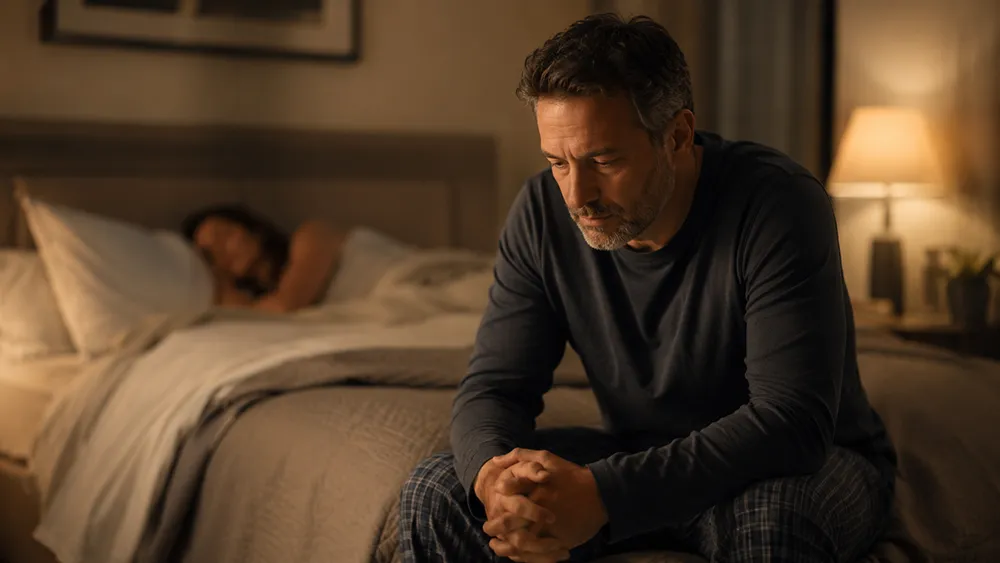
There’s a particular kind of torture that happens in the bedroom when your brain decides to stop being a participant and start being a critic.
One moment you’re in the moment. The next, you’re watching yourself from the ceiling, narrating your own performance like a disappointed sportscaster. Is this working? Does she seem bored? Why isn’t this working? Why am I thinking about whether this is working?
And just like that, you’re not having sex anymore. You’re failing a test you didn’t sign up for.
This is sexual performance anxiety (SPA) — and it’s more common than most men will ever admit, especially as they get older. It’s not a character flaw, a sign of weakness, or proof that something is permanently broken. It’s your brain doing something very predictable in a very unhelpful situation.
SPA tends to start small — one rough night, one moment of self-doubt — and quietly snowballs from there. Left unchecked, it can take a real toll on your sex life, your relationship, and your overall well-being.
The good news: predictable things can be understood. And things that can be understood can usually be fixed.
This post covers what sexual performance anxiety actually is, why it tends to get worse with age, what’s driving it, and — most importantly — practical strategies to overcome it before it does lasting damage.
Key Takeaways
- Sexual performance anxiety is a mental loop, not a physical failure — but it can absolutely cause real physiological symptoms, including erectile dysfunction.
- The loop is self-reinforcing: worry creates the problem it's afraid of. Once you understand the cycle, you can start to break it.
- Getting older changes your sexual response in ways that are completely normal — but if nobody told you about them, they can feel like warning signs.
- Most men can make real progress with behavioral techniques, mindset shifts, and better communication — no prescription required.
- When self-help isn't enough, there are effective professional options, from sex therapy to telehealth, that actually work.
What Is Sexual Performance Anxiety?
Sexual performance anxiety (SPA) is exactly what it sounds like: worry about your ability to perform sexually, usually triggered by anxiety or fear of failure, embarrassment, or not meeting expectations — your own or someone else’s.
Performance anxiety is a type of situational anxiety — it’s not a character flaw or a sign of broader sexual dysfunction, though it can lead to sexual problems if it goes unaddressed. It can show up as a pre-existing condition before sex even starts, or it can develop mid-encounter after something doesn’t go as planned.
It’s more prevalent in men who deal with generalized anxiety, body image concerns, or high personal standards around sexual performance issues. Women are affected too — this isn’t exclusively a male problem — but the visibility of male arousal makes performance anxiety particularly acute for men.
Common manifestations include:
- Difficulty getting or maintaining an erection
- Ejaculating too quickly — premature ejaculation is a frequent companion to SPA — or not being able to ejaculate at all
- Losing interest or arousal despite wanting to be engaged
- A persistent mental distraction that pulls you out of the moment
- Avoiding sexual activities or intimacy altogether to sidestep the pressure
Here’s the key distinction that trips a lot of men up: SPA and erectile dysfunction are not the same thing, even though they can look identical from the outside. ED is a physical condition with specific physiological causes — vascular issues, hormonal imbalances, nerve damage. SPA is a psychological condition that causes those same outward signs, including erectile difficulties.
The distinction matters because the treatment paths are different. A man with pure ED needs medical intervention. A man with SPA-driven erection problems needs to address what’s happening in his head. And plenty of men are dealing with both at once, which is where things get complicated.
If your erections are solid in low-pressure situations — morning wood is intact, you can get aroused without a partner present — that’s a meaningful clue that the plumbing is fine and the problem lives upstairs.
The Anxiety-Performance Loop
Understanding SPA requires understanding the loop it runs on. It’s almost elegant in how perfectly self-defeating it is.
It usually starts with a triggering event: a moment of sexual difficulty, a real or imagined signal of a partner’s disappointment, or just the accumulation of worry about whether you’ll be able to perform. That worry activates the sympathetic nervous system — the classic fight-or-flight stress response.
Here’s where it gets interesting. Sexual arousal and physical performance require the parasympathetic nervous system — the rest-and-digest counterpart. The two systems don’t play well together. Worry literally suppresses the physical response required for arousal, including blood flow to the penis. When the stress response kicks in, the body constricts blood vessels as part of its emergency protocol — which is exactly the opposite of what you need for an erection.
So anxiety or fear of not performing causes the body not to perform. The body failing to perform confirms the fear. The next encounter starts with more anxiety, which creates more failure, which creates more anxiety. Each episode can reinforce the pattern, making the loop harder to break — which is why SPA tends to compound rather than fade on its own.
This is why SPA tends to escalate rather than resolve on its own. It’s not just a bad night — it’s a feedback loop with no natural exit. Over time, intercourse starts to feel like a performance review rather than something pleasurable.
Psychologists have a term for the mental state that accelerates this loop: spectatoring. It’s what happens when you mentally step outside yourself and observe your own performance in real time — evaluating, critiquing, anticipating failure, racing thoughts running commentary while you’re trying to be present. Instead of being in the experience, you’re watching it like a nervous coach watching the clock.
Spectatoring kills arousal. It’s cognitively incompatible with the focused, in-body awareness that good sex requires. And once you know the term, you’ll recognize it immediately the next time it happens.
Breaking the loop — not just managing the symptoms — is the goal.
Why It Hits Harder as Men Get Older
SPA can show up at any age, but there are good reasons it tends to intensify in middle age and beyond. And they have less to do with decline than with misunderstanding.
As men age, sexual response changes in ways that are completely normal but often feel alarming:
- Arousal takes longer. The 18-year-old response time is gone. This is physiology, not failure — but if you interpret a slower erection as a warning sign, you’ve just handed your brain a reason to panic.
- Erections are less automatic. Younger men can get aroused from looking at a menu. Older men often need more direct stimulation and mental engagement. Again, normal — but easy to misread.
- Recovery time increases. The refractory period lengthens with age. A bad night has more psychological weight when the next opportunity is further away.
- Physical health factors emerge. Cardiovascular issues, lower testosterone, medications — these can affect sexual function, and the line between physical cause and psychological response gets blurry fast.
The result is that many men enter their 40s and 50s noticing real changes in their sexual response and start catastrophizing them. One slower-than-expected erection becomes “I’m losing it.” That thought becomes worry. That worry becomes SPA. Sexual performance anxiety often follows this exact pattern — and ED, when it develops alongside it, can make the spiral move faster.
There’s also a relational dimension. Long-term relationships carry accumulated history — including any tension, disconnection, or unexpressed frustration that’s built up over years. That emotional weight doesn’t stay outside the bedroom.
Common Causes of SPA
Sexual performance anxiety rarely has a single cause. More often, it’s a combination of biological and psychological factors — some situational, some physical — that converge at the wrong moment. The causes of sexual performance anxiety are worth understanding in depth because knowing your specific triggers is the first step toward addressing them.
Psychological roots are usually the primary driver. Anxiety or fear of judgment, poor body image, low self-esteem, depression, shame around sexuality and masturbation, penis size concerns, and social anxiety all create fertile conditions for SPA. Past trauma — including negative sexual experiences earlier in a man’s sexual history — can play a significant role and often goes unaddressed. Feeling anxious about a new sexual partner or entering a new sexual experience altogether is also common, especially after a period of being out of the dating pool.
Relationship issues matter enormously. Conflict, lack of trust, poor communication, and emotional distance don’t clock out when you get into bed. Neither does pressure — spoken or unspoken — around performance or frequency. These dynamics can make it harder to enjoy sex and easier to feel like you’re trying to please your partner rather than genuinely connect.
Pornography has become an increasingly significant factor, particularly for men who’ve been heavy consumers over time. Unrealistic expectations about performance, duration, and partner response can impact sexual satisfaction and create a gap between reality and the internal benchmark — and that gap breeds self-doubt.
Stress and sleep deprivation are underrated contributors. Chronic stress keeps cortisol elevated, which suppresses testosterone and generally degrades the conditions required for healthy sexual function. The muscle tension that comes with chronic stress doesn’t help either. Poor sleep compounds every psychological vulnerability.
Medical conditions — including cardiovascular disease, diabetes, hormonal imbalances, and certain medications — can affect blood flow and sexual function in ways that overlap with or trigger the performance loop. It’s worth ruling out physical causes with a healthcare provider, particularly if the problem is persistent.
Treating sexual performance issues often requires addressing both the emotional and physical sides of the equation.
How to Break the Cycle
There’s no single fix for sexual performance anxiety, but there are evidence-based practical strategies that work. The right combination depends on what’s driving your SPA — but most men find meaningful improvement by working through a few of these.
Mindset and Cognitive Reframing
The foundation of any approach to SPA is changing how you think about sex and performance.
Performance framing — treating sex as a test with pass/fail outcomes — is the core cognitive distortion that feeds the loop. Shifting to a pleasure and connection mindset, where the goal is mutual enjoyment rather than a specific outcome, removes the conditions that make anxiety spike. It’s much easier to maintain an erection and stay present when you stop keeping score.
This sounds simple and isn’t. But cognitive-behavioral therapy (CBT) techniques have a strong evidence base in this area. The basic process involves identifying the specific negative thought patterns that trigger anxiety (“I need to sustain an erection or she’ll be disappointed”), examining the evidence for and against them, and replacing them with more accurate and helpful alternatives.
CBT is one of the most evidence-based approaches available for these kinds of thought loops — including the ones that show up in sexual contexts. You don’t need a professional to start doing some version of this work, though working with one makes it significantly more effective.
Simply noticing when spectatoring starts and deliberately redirecting attention to physical sensation is a meaningful first step toward overcoming performance anxiety. The goal is to shift from observer to participant.
Behavioral Techniques
Sensate focus is one of the most effective and most underused tools for SPA. Developed by Masters and Johnson, it involves a structured series of sexual activities — usually done with a sexual partner — that deliberately remove the pressure of performance.
The early stages involve non-genital touching with no expectation of arousal or sex. The goal is to rebuild comfort with physical intimacy and make the experience pleasurable without the overlay of performance. It sounds almost too low-key to work, but it works extremely well.
Mindfulness practices — particularly body-scan meditation and focused breathing — help train the attention away from critical self-observation and back into physical sensation. Regular mindfulness practice changes how the brain responds to anxious thoughts, and that mental chatter typically loses some of its grip with consistent practice. A few minutes of mindfulness before sexual activity can also reduce the initial spike of worry and help you last longer.
Reducing pressure around erections specifically means taking the erection off the table as a success metric, at least temporarily. This is easier said than done, but partners who understand what’s happening can be crucial allies here — which brings us to communication.
Communication With a Partner
This one is hard and non-negotiable.
Trying to manage SPA silently — performing around it, hoping your partner doesn’t notice, quietly dreading intimacy — makes everything worse. It adds the cognitive load of concealment to an already overloaded system, and it prevents your partner from being an asset in the process.
Being open with your partner about what’s going on is one of the most effective things you can do. Most partners respond with more empathy and less judgment than men expect. And a partner who understands that performance pressure is the enemy can actively help remove it — creating a non-critical space where pleasure and connection matter more than outcomes.
This doesn’t require a clinical sit-down conversation. It starts with honesty: “I’ve been in my head during sex lately, and it’s getting in the way. I want to talk about it.”
Therapy Can Help — More Than Most Men Expect
When self-directed approaches aren’t enough — or when the SPA is rooted in deeper issues like past trauma, depression, or significant relationship issues — professional support is the right move.
Cognitive behavioral therapy with a therapist who has experience in sexual health is highly effective for SPA. It provides structure, accountability, and a trained perspective on the specific thought patterns driving the anxiety. Talk therapy in this context isn’t just about feelings — it’s a structured, practical process aimed at lasting change.
A sex therapist is a specialized clinician focused specifically on sexual problems. Treating sexual performance issues through sex therapy typically combines behavioral techniques like sensate focus with psychological work — often the most direct route to lasting change. Couples therapy can help when the SPA is significantly affecting your relationship, giving both partners tools to navigate it together.
Finding the right professional takes some effort, but it’s among the highest-ROI moves available for genuine SPA.
Medical and Telehealth Options
When anxiety and physical erection problems are tangled together — which happens frequently in older men — medical support may be appropriate alongside psychological work.
PDE5 inhibitors (sildenafil, tadalafil, and their generics) are sometimes used strategically in SPA treatment, not to address a physical deficiency but to reduce the psychological pressure around erection loss. Anxiety plays a role even here: knowing that backup exists can, paradoxically, reduce the need for it. Blood flow to the penis is restored by these medications, which can break the loop long enough for confidence to rebuild.
Telehealth platforms have made access to this kind of support significantly easier. A discreet online consultation with a healthcare provider can assess whether underlying health factors are contributing and whether medication makes sense as part of a broader approach.
When to See a Doctor or Therapist
Most mild-to-moderate SPA responds well to the self-directed techniques above. But some situations warrant professional support sooner rather than later:
- The anxiety has caused you to lose interest in sex or avoid intimacy altogether
- You’re experiencing symptoms of depression alongside the sexual difficulties
- You’ve noticed physical symptoms like declining morning erections or changes in sensation alongside the performance issues
- The problem has been ongoing for more than a few months without improvement
- You suspect physical causes — particularly if morning erections have declined or you have risk factors for cardiovascular disease
- The issue is creating real strain in your relationship
There’s no trophy for handling this alone, but talking to your doctor can make all the difference in the world. Therapy can help even when you’re convinced it won’t — that skepticism is itself a common symptom of the problem.
The most effective approach to persistent SPA almost always involves professional support, whether that’s a therapist, a doctor, or a combination. Telehealth has made that first step considerably lower-friction than it used to be, and it’s worth taking advantage of that.
Frequently Asked Questions (FAQs)
Is sexual performance anxiety a common sexual problem?
Very. Sexual performance anxiety happens to men of all ages and sexual orientations, and it’s one of the most common sexual problems men bring to doctors and healthcare providers. The fact that most men don’t talk about it openly makes it feel more isolated than it is. You’re not the outlier — you’re just not hearing the conversation.
Can sexual performance anxiety cause erectile dysfunction?
Yes, and this is one of the most important things to understand. The mind-body connection here is direct: a stress response actively constricts blood vessels and interferes with arousal. Over time, repeated poor experiences can compound into patterns that look a lot like physical ED. The good news is that anxiety-driven erectile difficulties are highly treatable once you address the underlying psychological loop.
Of course, it’s a good idea to dig deeper if you are figuring out whether you are dealing with SPA or ED.
Is sexual performance anxiety different in men than in women?
The experience is more prevalent in men than in women, largely because erection and ejaculation are visible and binary in a way that female arousal isn’t — there’s no hiding a bad night in the same way. That said, women are affected by performance anxiety too, often around self-image, ability to orgasm, or fear of not being pleasurable enough for a partner. The anxiety loop is the same; the triggers differ.
What’s the difference between sexual performance anxiety and general anxiety?
Sexual performance anxiety is a type of situational anxiety — it’s specifically tied to sexual contexts rather than being a pervasive feature of daily life. A man can be calm and confident in every other area and still experience significant SPA. That said, men who deal with generalized anxiety disorders tend to be more vulnerable to it. The causes of sexual performance anxiety are both independent of and overlapping with broader psychological conditions.
How long does it take to overcome sexual performance anxiety?
It depends on the severity and what’s driving it. Men with mild SPA who apply mindfulness, reframe their expectations, and communicate with their partner often see meaningful improvement within weeks. Men dealing with deeper-rooted anxiety, relationship issues, or overlapping physical factors typically benefit from working with a professional over several months. Overcoming performance anxiety isn’t usually a single breakthrough — it’s a gradual reclaiming of confidence and presence. CBT-based approaches typically show results within 8–16 sessions.
When should I see a doctor versus a therapist for sexual performance anxiety?
See a doctor first if you suspect a physical component — particularly if erection problems are occurring in all contexts (including solo), if morning erections have disappeared, or if you have risk factors for cardiovascular or metabolic conditions.
See a therapist if the problem appears primarily in partnered sexual situations and your erections are otherwise reliable. Many men benefit from both, and telehealth platforms have made it easier to consult a healthcare provider quickly before committing to a longer process.
Can sexual performance anxiety affect my relationship long-term?
It can, if it goes unaddressed. The avoidance and silence that typically accompany SPA can erode intimacy and create distance that outlasts the sexual problem itself.
The fix isn’t just resolving the performance loop — it’s rebuilding the emotional and physical connection with your partner through honest communication. Couples working with a sex therapist can make a real difference when the impact on the relationship has become significant.
Conclusion
Sexual performance anxiety is the brain doing something completely logical — protecting you from perceived failure — in a completely counterproductive way.
The loop it runs on is predictable. The triggers are identifiable. And the practical strategies for interrupting it are well-established and genuinely work for most men who apply them with patience and consistency.
Getting older means your sexual response changes. It does not mean your sex life is in permanent decline or beyond recovery. The men who navigate this well are almost always the ones who stop treating every imperfect moment as evidence of catastrophe — and start treating it as information about what needs attention.
Start somewhere. The loop breaks when you start interrupting it.