The Question Most Men With SPA Never Ask
Most men who experience sexual performance anxiety (SPA) spend their energy focused on what’s happening:
- The erection that won’t cooperate
- The thoughts that won’t quiet down
- The slow drift toward avoiding intimacy altogether
Very few stop to ask why.
That’s a problem. Because the fastest path to fixing SPA isn’t managing the symptoms, it’s identifying the specific triggers driving it. And those triggers are almost never random.
SPA doesn’t arrive out of nowhere. It develops through identifiable psychological and physiological pathways, gets reinforced by specific patterns of behavior, and sticks around because the brain is very good at learning lessons it was never meant to learn.
Understanding what taught your brain to treat sex as a threat is the first step toward unteaching it.
This post goes deeper into the causes than most. Not because the list is interesting, but because knowing your specific combination of triggers is what makes the solutions actually work.
Key Takeaways
SPA doesn’t come out of nowhere — and once you know your triggers, you’re already halfway to fixing them.
- Sexual performance anxiety almost never has a single cause. Most men are dealing with several triggers stacking on top of each other.
- Psychological factors are the most common primary driver — but physical and lifestyle contributors can start the process or make it significantly worse.
- Relationship dynamics play a bigger role than most men acknowledge, and they're often the hardest to see clearly from the inside.
- The reason SPA sticks isn't the original trigger — it's the reinforcement loop that follows. One bad experience trains the brain to expect the next one.
- Identifying your specific triggers isn't just academic. It's the practical foundation for every effective treatment approach.
Performance Anxiety Is a Learned Response
Before getting into the specific causes, it helps to understand what’s actually happening at the neurological level because SPA is NOT a character flaw, a sign of aging, or proof that something is broken. It’s a learned response.
The brain’s primary job is threat detection and pattern recognition. When something goes wrong during sex, an erection fails, a partner reacts badly, anxiety spikes at the wrong moment, the brain files that as a potentially threatening situation. The next time a similar situation arises, it starts scanning for danger before anything has even happened.
This is the same mechanism behind any conditioned fear response. A soldier who’s been in combat becomes hypervigilant in loud public spaces. A man who’s had an embarrassing sexual experience becomes hypervigilant in intimate situations.
The brain isn’t malfunctioning; it’s doing exactly what it evolved to do. It’s just applying threat detection in a context where it’s actively harmful.
What makes SPA particularly persistent is that the response itself creates the outcome the brain was trying to avoid. The hypervigilance triggers a stress response. The stress response suppresses arousal. The arousal failure confirms the threat. The pattern gets reinforced. And so it goes.
Understanding this mechanism matters because it reframes the question. You’re not asking “what’s wrong with me?” You’re asking, “What taught my brain this pattern, and how do I teach it something different?”
Psychological Causes
Psychological factors are the most common primary driver of sexual performance anxiety, and they’re worth examining in detail because most men have more than one operating simultaneously.
Fear of Judgment and People-Pleasing
At the core of most SPA is some version of the same fear: I’m going to disappoint someone, and that will mean something bad about me.
This fear shows up differently in different men.
For some, it’s about satisfying a partner.
For others, it’s about living up to some internal standard of what a man is supposed to be capable of.
For others, still, it’s a generalized anxiety about being evaluated and found wanting, a pattern that often predates the bedroom by decades.
Men with high people-pleasing tendencies who’ve built much of their identity around being competent, reliable, and capable are particularly vulnerable.
Sex is one of the few contexts where effort doesn’t directly produce results. You can’t willpower your way to an erection. That loss of control is deeply threatening to a man who’s used to performing.
Low Self-Esteem and Negative Self-Talk
Low self-esteem creates a kind of cognitive filter that makes negative outcomes feel inevitable and positive experiences feel like flukes. A man with genuinely good self-esteem can have a bad night and chalk it up to circumstances. A man with low self-esteem has a bad night and updates his entire self-concept.
The internal monologue matters enormously here. Negative thought patterns like “I knew this would happen,” “she must be disappointed,” or “I’m not good enough in bed” don’t just reflect anxiety; they actively generate it.
Each thought is a small activation of the stress response, another brick in the wall between the man and his own arousal.
Depression
Depression and sexual performance anxiety have a complicated, bidirectional relationship. Depression suppresses libido, reduces sensitivity to pleasure, and blunts the emotional engagement that good sex requires. These effects can trigger SPA directly when arousal is blunted by depression. Men often interpret it as failure rather than a symptom.
Going the other direction, persistent SPA can contribute to depression. Sexual dysfunction, relationship strain, and the shame that often accompanies both are well-documented pathways to depressive episodes.
If depression is in the picture, it almost always needs to be addressed alongside the SPA rather than treating one and hoping the other resolves.
Poor Body Image
Body image issues in men are underreported and underappreciated as a driver of sexual performance anxiety.
The cultural conversation about body image tends to focus on women, which leaves men without language for what they’re experiencing and often without the permission to take it seriously.
Poor body image can manifest as a distraction during sex. The tendency to mentally check out of the experience and start evaluating your own performance in real time, or to outright avoid situations where the body is exposed.
Either way, the cognitive load of managing body-related self-consciousness competes directly with the mental presence required for arousal and connection.
Weight, fitness level, penis size anxiety, and concerns about physical aging all fall into this category. The specific content varies; the mechanism is the same.
Past Sexual Trauma
Past trauma — including experiences that the man may not label as trauma — is a significant and often unaddressed cause of SPA. This includes overtly traumatic experiences like sexual assault or coercion, but also subtler events: a humiliating early sexual experience, an unkind or mocking response from a partner, a string of failures that left a lasting imprint.
The brain doesn’t distinguish neatly between “big T” and “little t” trauma when it comes to conditioned responses. A single intensely negative sexual experience can be enough to wire in an anticipatory anxiety pattern that persists for years.
Men are also less likely than women to seek help for trauma-related sexual difficulties and less likely to identify past experiences as relevant to current problems.
If this resonates, it’s worth examining and worth bringing to a therapist who has experience in sexual health.
Generalized Anxiety and Social Anxiety
Men who already live with generalized anxiety or social anxiety carry a higher baseline level of threat-alertness into every situation, including intimate ones. The specific content of their anxiety may shift, but the underlying mechanism is the same one that fires in sexual contexts.
Social anxiety in particular is a meaningful risk factor. The fear of negative evaluation, the heightened self-consciousness in interpersonal situations, and the tendency to over-monitor one’s own behavior are all directly transferable to the bedroom.
A man who dreads being judged at a dinner party is using the same neural machinery that drives spectatoring during sex.

Relationship and Partner Dynamics
The relationship context is one of the most significant and most overlooked contributors to sexual performance anxiety and decreased intimacy. Men tend to locate the problem inside themselves, which is sometimes right and sometimes a way of avoiding a harder conversation about what’s happening between them and their partner.
Unspoken Pressure and Communication Breakdown
Pressure around sexual performance doesn’t have to be explicit to be real. A partner who seems distracted, disappointed, or impatient, even without saying anything, can create an atmosphere of evaluation that feeds directly into the performance loop.
And when men don’t talk about what they’re experiencing, their partners are left to fill in the gaps with their own interpretations, which are often wrong and make things worse.
The partner assumes the man isn’t attracted to her anymore. The man interprets her withdrawal as a sign of disappointment. The dynamic deteriorates without either person understanding what’s actually happening.
Communication breakdown is both a cause of SPA and a primary perpetuating factor. Being open with your partner about what’s happening before it becomes a pattern is one of the highest-leverage things a man can do.
Emotional Distance and Accumulated Conflict
Sex doesn’t happen in a vacuum. Whatever tension, resentment, unresolved conflict, or emotional distance has built up in a relationship doesn’t clock out at the bedroom door.
For many men, emotional disconnection from a partner is a primary inhibitor of arousal, not because there’s anything physically wrong, but because genuine sexual engagement requires a degree of psychological safety that conflict and distance undermine.
This is particularly true in long-term relationships, where years of accumulated history, positive and negative, are always in the room.
Fear of Disappointing a Partner
This one deserves its own mention because it operates somewhat independently of the relationship’s actual health.
A man can be in a supportive, communicative relationship with a genuinely understanding partner and still carry an intense fear of disappointing her sexually because the fear is rooted in his own self-concept, not in her actual expectations.
The gap between a partner’s real expectations and a man’s imagined version of those expectations is often enormous. Most partners want connection and presence far more than they want flawless performance.
Men who understand this intellectually but can’t integrate it emotionally are dealing with a belief system that needs direct attention, usually through some form of cognitive work.
New Relationships vs. Long-Term Dynamics
SPA shows up differently depending on the relationship context, but it shows up in both contexts.
In new relationships, the triggers tend to be external: unfamiliarity with a new partner, desire to make a good impression, uncertainty about what the partner wants. The pressure is front-loaded.
In long-term relationships, the triggers tend to be internal and accumulated: the weight of history, changing bodies and sexual responses, the gradual erosion of novelty, and the quiet pressure that comes from a partner who knows you well enough to notice when something’s off.
Both contexts are real. Neither is more legitimate than the other.
The Pornography Factor
Pornography deserves its own section, not because it’s the most common cause of SPA, it isn’t, but because its contribution is frequently misunderstood, underestimated, or flatly denied by the men it’s affecting.
The core problem isn’t moral. It’s benchmarking.
Heavy pornography consumption creates a reference library of sexual performance that is systematically unrealistic in terms of duration, erection quality, body types, partner responses, and what “normal” sex looks like. When a man’s real sexual experiences are unconsciously measured against that library, the gap can be significant enough to generate genuine performance anxiety.
This happens through a few distinct mechanisms:
Unrealistic performance benchmarks. Porn performers are selected for specific physical characteristics, use pharmaceutical assistance, are filmed across multiple sessions, and have the benefit of editing. Comparing real-world erections and real-world stamina to this standard is like comparing a recreational jogger to a marathon highlight reel.
Desensitization to real-world stimulation. Regular high-stimulation pornography consumption can reduce arousal response to lower-stimulation real-world sexual situations. When a man finds himself less aroused with a real partner than with pornography, the experience can read as sexual failure, triggering exactly the anxiety loop that makes it worse.
Partner response expectations. Pornography consistently misrepresents how partners respond to sex in terms of enthusiasm, vocalization, and what they find pleasurable. Men who’ve internalized these representations can find real intimacy disorienting and can misread a partner’s normal responses as signs of their own inadequacy.
None of this means pornography is always problematic. But for men who are experiencing SPA and who are regular consumers, it’s worth an honest audit of whether their mental benchmarks are calibrated to reality.
Physical and Lifestyle Contributors
Psychological causes get most of the attention in discussions of SPA, but physical and lifestyle factors are significant contributors both as direct causes and as amplifiers of existing psychological vulnerability.
Chronic Stress and Cortisol
Chronic stress keeps cortisol elevated. Elevated cortisol suppresses testosterone production, blunts the parasympathetic nervous system activity required for arousal, and generally degrades the physiological conditions that healthy sexual function depends on.
This means that a man under sustained work, financial, or personal stress isn’t just distracted during sex; his body is actively in a state that’s physiologically opposed to arousal.
The stress response and the sexual response are running competing programs, and the stress response has evolutionary priority.
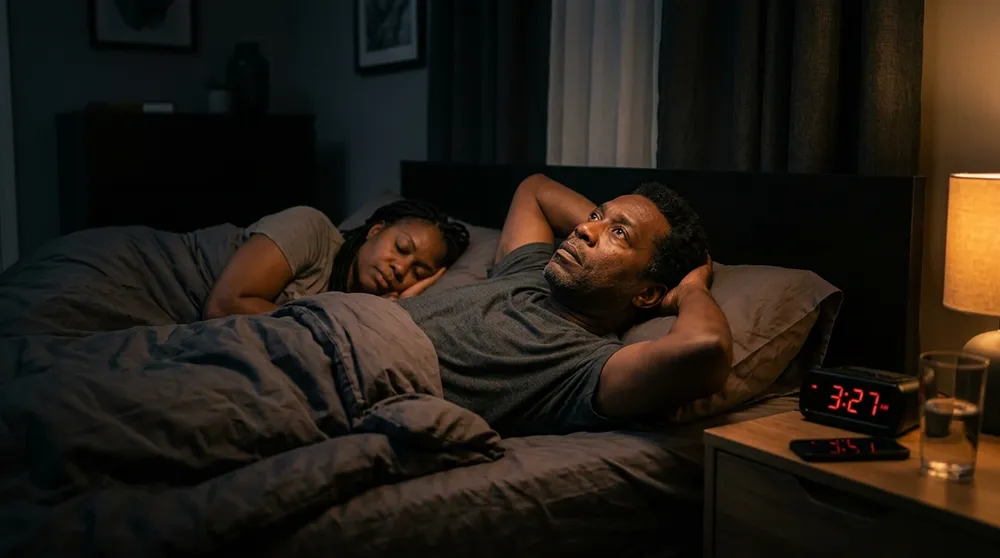
Sleep Deprivation
Sleep is when testosterone production peaks, when the body recovers from the physiological effects of stress, and when the nervous system resets.
Chronic sleep deprivation hits sexual function from multiple directions simultaneously, lowering testosterone, increasing cortisol, degrading mood, and reducing the cognitive resilience that helps men manage anxiety in the moment.
Men who are sleeping poorly and experiencing SPA should treat the sleep problem as a first-order issue, not an afterthought.
Alcohol
Alcohol is worth addressing directly because of its complicated relationship with sexual performance.
In small amounts, it reduces inhibition and can ease performance anxiety in the short term.
In larger amounts, it significantly impairs erectile function, hence the clinical term “whiskey dick.”
The problem for men with SPA is that alcohol can become a crutch used to manage anxiety before sex, which eventually creates its own performance problems.
A man who finds he can only perform after several drinks has traded one problem for another and added a dependency layer on top of it.
Cardiovascular Health and Blood Flow
Erection quality is directly tied to cardiovascular health. The penis is a vascular organ, and achieving and maintaining an erection requires healthy blood flow through arteries that respond to the same risk factors as coronary arteries. Hypertension, high cholesterol, insulin resistance, and physical inactivity all impair the vascular response on which erections depend.
This matters for SPA because men who have mild vascular impairment may not have clinically diagnosable erectile dysfunction (ED) but may notice that their erections are less reliable or less firm than they used to be.
When those changes are misinterpreted as psychological failure rather than a physical signal, they become the seed of a performance anxiety loop.
Low Testosterone and Hormonal Changes
Testosterone declines gradually with age in most men, with a more significant drop in some. Low testosterone reduces libido, can impair erection quality, affects mood and energy, and generally makes the physiological substrate for healthy sexual function less robust.
It’s worth distinguishing between the normal gradual decline of aging and clinically low testosterone (hypogonadism), which has specific symptoms and specific treatments. A man who suspects low T is a factor should get his levels checked. It’s a simple blood test and one of the more actionable items on this list.
Medications
A significant number of commonly prescribed medications have sexual side effects that are underreported, underacknowledged, and often not discussed at prescribing. The main categories:
SSRIs and SNRIs (antidepressants) are among the most common culprits. They can reduce libido, delay or prevent orgasm, and impair erection quality in a significant percentage of users. Men who started experiencing sexual difficulties around the time they started an antidepressant should raise this with their prescribing doctor.
Antihypertensives (blood pressure medications), particularly beta-blockers and certain diuretics, can impair erectile function through their effects on blood flow and the nervous system.
Finasteride (used for hair loss and prostate issues) carries a risk of sexual side effects, including reduced libido and erectile difficulties, that can persist even after stopping the medication in some men.
If you’re on any of these medications and experiencing sexual difficulties, talk to your doctor before making any changes. There are often alternatives worth exploring.
Why It Sticks: The Reinforcement Mechanism
Understanding the original triggers matters. But it doesn’t fully explain why SPA is so persistent, why a problem that might start with a single bad experience can still be running the same loop months or years later.
The answer is anticipatory anxiety and behavioral reinforcement.
After a negative sexual experience, the brain doesn’t just remember what happened. It starts predicting what will happen next time.
This is anticipatory anxiety: the anxiety that fires before the situation even begins, based on what the brain expects. By the time a man is in an intimate situation again, his stress response is already partially activated, which means he’s starting from a compromised position before anything has occurred.
This anticipatory pattern is self-confirming. Because he’s already anxious going in, performance is more likely to be affected. The affected performance confirms the brain’s prediction. The prediction becomes more entrenched. The anticipatory anxiety arrives earlier and stronger the next time.
Avoidance reinforces the loop from the other direction. When a man starts avoiding sexual situations, turning down opportunities, creating distance from his partner, and finding reasons not to initiate, he temporarily escapes the anxiety. That escape feels like relief. The brain registers avoidance as an effective coping strategy. The avoidance becomes more likely next time.
What avoidance actually does is prevent the new positive experiences needed to recalibrate the brain’s threat assessment. The loop stays intact, locked in by the very behavior that was meant to protect against it.
This is why SPA that goes unaddressed tends to compound rather than fade. And it’s why treatment approaches are specifically designed to interrupt the reinforcement pattern, not just address the original triggers.
When Multiple Causes Stack
Here’s the reality that makes SPA genuinely difficult for most men: it’s rarely one thing.
A man might come in with low self-esteem (psychological), a long-term relationship with accumulated tension (relational), chronically poor sleep (lifestyle), and a habit of heavy pornography consumption (benchmarking) — all operating simultaneously. Any one of those factors alone might be manageable. Together, they create a cumulative load that makes the anxiety loop almost inevitable.
This is important for two reasons. First, it means that addressing only one factor while ignoring the others often produces limited results. The man who fixes his sleep but doesn’t address the relationship tension will see partial improvement at best.
Second, it means that the question “what’s causing my SPA?” doesn’t always have a clean answer, and that’s okay. The goal isn’t a perfect diagnosis. It’s an honest inventory of what’s contributing, so that the effort to address it can be distributed appropriately.
Some men find it useful to work through this with a therapist who specializes in sexual health. Others do productive self-reflection on their own. Either way, the exercise of asking the question specifically and honestly is where recovery begins.
Conclusion
Sexual performance anxiety doesn’t stick around because men are weak or broken or past their prime. It sticks around because the brain is doing exactly what it’s built to do: learning from experience, anticipating threats, and reinforcing the behaviors that seem to offer protection.
The triggers that start the process are real and identifiable. The reinforcement mechanism that keeps it going is understandable and interruptible. And the combination of factors driving your specific experience, once you’ve taken an honest look at them, is the map you need to start finding your way out.
Now that you understand what causes SPA, finding the right path to Overcome Sexual Performance Anxiety is the next step.
Frequently Asked Questions (FAQs)
Does masturbation cause sexual performance anxiety?
Masturbation itself doesn’t cause SPA, but the habits around it can contribute. Frequent masturbation immediately before partnered sex can temporarily affect arousal and erection quality, especially if partnered sex is attempted during your refractory period, which some men misread as dysfunction.
The bigger issue is usually the content consumed during masturbation rather than the act itself — see the pornography section above.
Can masturbation guilt trigger performance anxiety?
Yes, guilt and shame regarding jerking off are more common than most men admit. Men who grew up with religious, cultural, or family messaging around masturbation being shameful or wrong sometimes carry a generalized sexual guilt into adulthood that surfaces during partnered sex.
The specific act changes, but the shame response doesn’t, and shame is one of the more reliable arousal killers there is.
Can problems with ejaculation be a sign of SPA?
Absolutely. SPA doesn’t only show up as erection problems. Premature ejaculation, delayed ejaculation, and difficulty reaching orgasm altogether are all common manifestations of performance anxiety.
The stress response affects the entire sexual response cycle, not just the erection, and men who are locked in their heads during sex often find their ejaculatory response is the first thing to go haywire.
Does penis size actually contribute to SPA?
For a significant number of men, yes. However, the perception of size is almost always the driver rather than actual size.
Research consistently shows that most men who are anxious about penis size fall well within the normal range.
The problem is that the internal benchmark is usually calibrated to pornography, locker room mythology, or other unreliable sources rather than reality. That gap between perceived inadequacy and actual adequacy is enough to generate real, sustained performance anxiety.
Can morning erections tell me anything about my SPA?
Yes, and they’re one of the most useful diagnostic signals available for figuring out whether you are dealing with SPA or ED.
If you’re waking up with regular morning erections but struggling to maintain one during partnered sex, that’s strong evidence that the problem is psychological rather than physical. The vascular and neurological equipment is working fine; it’s the mental context that’s interfering. Absent or significantly reduced morning erections, on the other hand, are worth discussing with a doctor. They can indicate a physical component that needs its own attention.